
Between Two Places
On identity, distance, and learning to see differently.
One Stop Over is currently a free publication. However, if you feel the overwhelming urge of generosity sweeping over you and you enjoy my work, you can support me in several ways…
I feel like I belong and don’t at the same time.
For much of my teens and twenties, I was a roamer. I moved from place to place, never very good at maintaining friendships, and never forming a strong attachment to where I was. Once I left somewhere, that was it. I rarely looked back. I don’t think that feeling is unique to me. Lots of people who live that way carry a quiet uncertainty about who they are and where they belong. It’s not always obvious when you’re younger. It’s certainly why I’m so drawn to the coast. At the time, it just feels like movement. Freedom, even. It’s only later that you start to question what that movement has cost you.
I first left the UK in 1998. I was away for three years, then returned to finish college before leaving again in the early 2000s. That time it was supposed to be permanent. I came to the United States to build a life and, over time, that is exactly what I did. I became a citizen 13 years ago. My life is here now. My family, my routines, my sense of home. When I was younger, I never really thought about how that decision might feel twenty years later. It was all forward motion. There was no real consideration for what it meant to leave one place behind in order to build something somewhere else. Lately, that has started to change.
Maybe it is just part of getting older, but over the past few years I have found myself thinking more about where I fit. Especially now, in a time where conversations about immigration and identity feel more charged than ever. It has made me more aware of how I am seen, and how I see myself. I exist in a kind of in between. I am a US citizen, but the moment I open my mouth it is clear I am not from here. There is always a question that follows. Where are you from? How long have you been here? It’s not meant in a negative way, but it is a reminder all the same.
And when I go back to England, the place that should feel like home, I have started to notice that it does not feel quite the same either. The familiar has become unfamiliar. Places I once knew without thinking now feel new again. I find myself looking at them more carefully, almost as if I am seeing them for the first time. It is a strange experience. To feel like a visitor in a place that once defined you.
People often ask me if I miss the UK. It’s a simple question, but it never has a simple answer. It usually carries an assumption that somewhere else must be better than where you are. That the grass is greener somewhere else. For me, the answer has always been more grounded than that. I miss my family. That has become more pronounced as they have gotten older. There is a distance there that no amount of phone calls or visits can really close. And there is a part of me that feels guilt for not being closer as time has moved on. And I miss the English countryside. The South Coast in particular.
There is something uniquely English about the idea of public access. A quiet, shared understanding that people can walk across farmland and private land through a network of footpaths and bridleways that have existed for generations. It is a system built on trust and respect, and it allows you to move through the landscape in a way that feels deeply connected. It is something that many Americans struggle to understand. The idea that landowners would allow that kind of access feels foreign here. But to me, what feels strange now is the opposite. That in the United States, we often charge people to access places like beaches, sometimes at a scale that feels hard to justify.
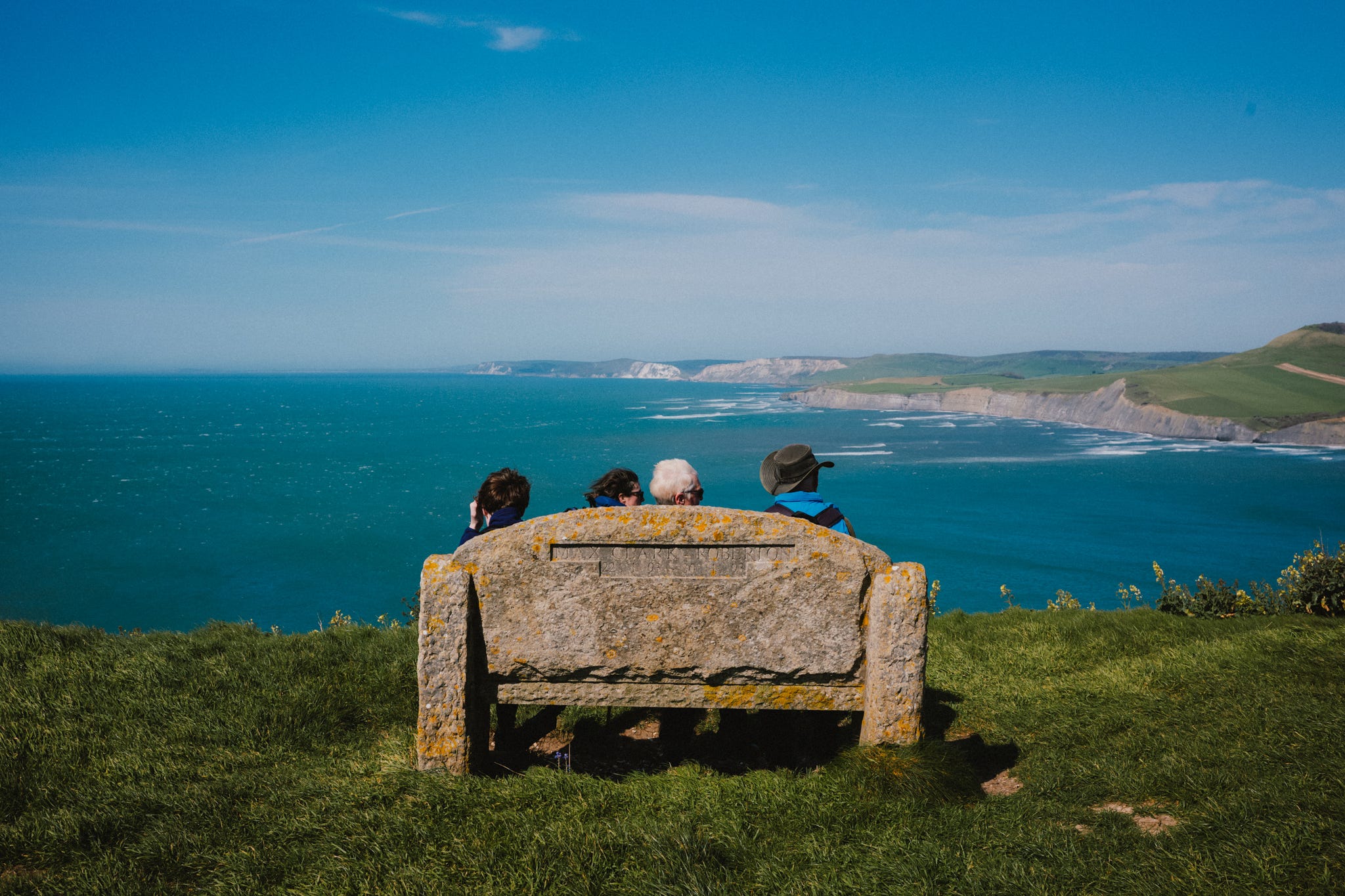
Last week, I found myself back on the South Coast, in Dorset. Walking along the Jurassic Coast. It is a place I have known for most of my life. A place that has shaped my understanding of landscape and space without me ever really thinking about it. But this time felt different. As I went through the images I made on that trip, I started to notice a shift in how I was seeing. Time and distance had changed something.
The ordinary felt more interesting. The small details stood out. Things I would have walked straight past as a kid were now the things that held my attention. A worn path cutting through a field. The way light moved across the cliffs. The quiet moments between people. I was no longer seeing the place as someone who belonged there. I was seeing it as an outsider. And for the first time, I started to wonder if that might not be a bad thing.
There is a certain clarity that comes from distance. When something is no longer completely familiar, you are forced to pay attention again. You notice things you once overlooked. You slow down. You observe. That sense of being in between, of not fully belonging to one place or another, might actually be what allows me to see more clearly. Not as someone rooted in a single place, but as someone constantly reinterpreting it. Maybe that is what photography has been for me all along. A way of making sense of where I am by paying closer attention to what is in front of me. A way of reconnecting to places that feel both familiar and unfamiliar at the same time.
I used to think that not fully belonging anywhere was something to fix. Something that would eventually resolve itself if I just stayed still long enough. Now I am not so sure. Maybe it is not a flaw. Maybe it is the thing that shapes how I see.
Here are some of the photos from this trip:


The life of living in a country that is not the country of your birth or the country where you spent your life before adulthood is a strange thing. I've lived in Korea for over 17 years. It's a place that I grew to love, but it doesn't necessarily love me back. Because of this, it leaves me feeling beyond twisted at times. I don't fit in where I grew up and I don't fit in where I've spent the last 17 years. I'm largely tolerated but not accepted. It's strange. I go back to America every year to visit family and I love it, but I would probably feel even more out of place there if I didn't have family there. Even things as simple as visiting a mart in America feels weird. Many things that I grew up loving have changed almost beyond recognition for me.
This hit a spot, Tom. I've never lived outside the UK but I have lived in England, Wales, Scotland and then back to England. My home town is close to Manchester. I haven't lived there since 1988. My relocations have all been driven by work. All allowed me to grow to like (even love) some of the places where I lived but, other than where I live now, I couldn't say where is "home". I've been back to my "home town" many times (though not for a while) and it has changed so much as to be almost unrecognisable. In a way, that prevents me becoming melancholic or homesick. At 65, I've come to accept that nowhere is what I'd regard as a long-term option anymore.